Posted on Leave a comment

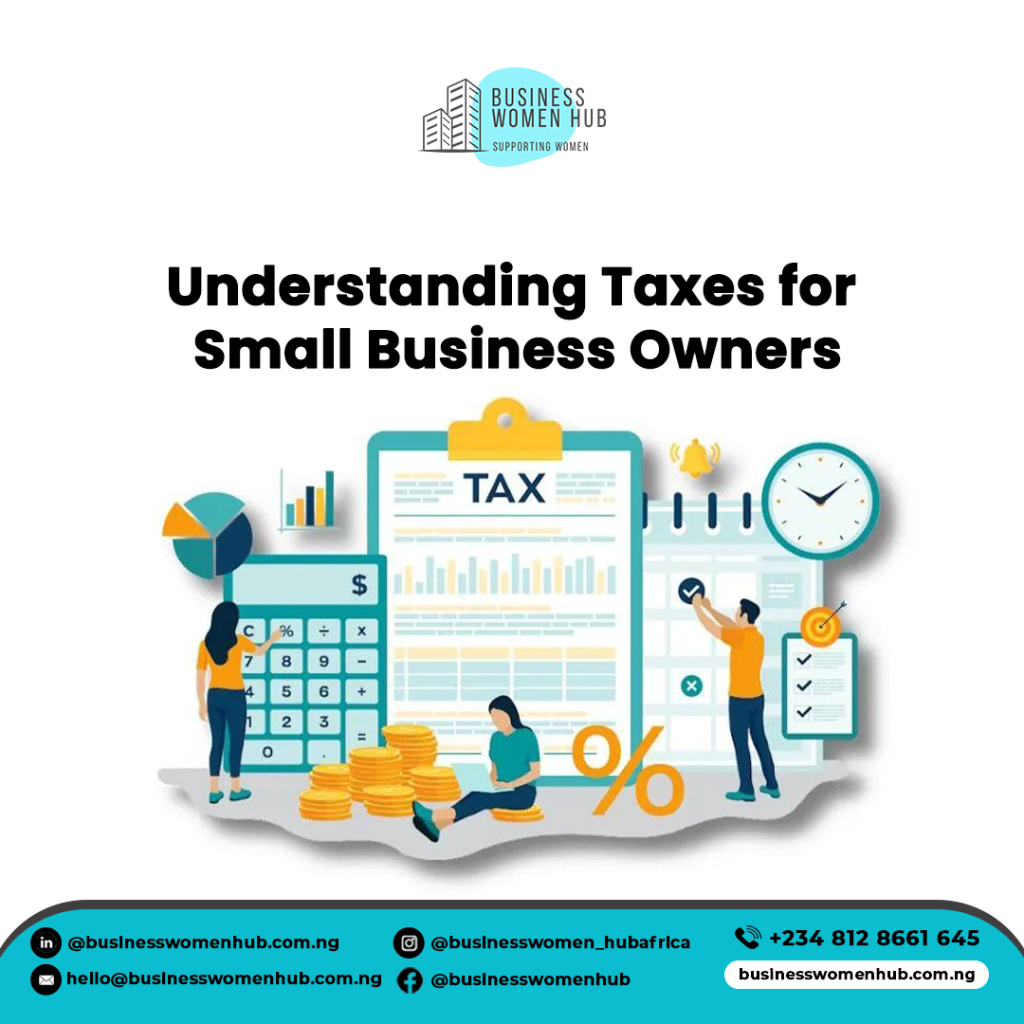
Understanding Taxes for Small Business Owners: How Tax Intelligence Can Power Your Growth

For many small business owners, the word tax often comes with stress, confusion, or fear. But here’s the truth: tax knowledge is not just about compliance, it’s about control, stability, and growth.

With the Nigeria Tax Act 2025/2026 reforms, the government has taken steps to simplify tax structures and offer significant relief to small businesses. However, these benefits only work for you if you understand the rules and act intentionally.

Let’s break it down into what truly matters for your business.

Tax Intelligence Is Business Power

Growing your business means understanding how tax laws apply to you, not avoiding them. Under the new tax reforms, many small businesses now enjoy exemptions and reliefs that can free up cash and reduce financial pressure.

Here’s what every small business owner should know:

  • Know your category: If your business has an annual turnover of ₦100 million or less, and fixed assets under ₦250 million, you may qualify as a small company under the law.
  • Enjoy tax reliefs: Eligible small companies may pay 0% Companies Income Tax, Capital Gains Tax, and Development Levy, a powerful advantage.
  • Formalization is key: To benefit, your business must be properly registered and have a Unified Taxpayer Identification Number (UTIN).
  • Compliance reduces risk: Knowing when and how taxes apply protects you from penalties and unexpected liabilities.

Intentional tax planning equals business stability and future growth.

Good Records Are Your Tax Superpower

The new tax law doesn’t only focus on rates; it emphasizes how businesses report and prove their numbers. Record-keeping is no longer “just admin,” it’s a strategic business tool.

To stay in control:

  • Organize daily: Keep records of revenue, expenses, receipts, invoices, and bank statements in one place.
  • Adopt digital tools: The reforms encourage digital tax filing and e-invoicing. Using accounting software early will save you stress later.
  • Separate finances: Always keep personal and business accounts separate for clarity and accuracy.
  • Understand VAT: Even if you’re exempt from Companies Income Tax, VAT may still apply to your invoices. Know when to charge VAT and when you can claim input VAT credits.
  • Review monthly: Regular check-ins help you catch issues early instead of scrambling during tax season.

Good records mean less stress and more opportunities to save.

Plan for Taxes, Don’t Just Pay Them

Taxes don’t have to be unpredictable. With the right planning, they become a manageable and expected part of your business journey.

Here’s how to stay ahead:

  • Forecast your obligations: Monitor your revenue trends to know whether you’ll remain under exemption thresholds or move into taxable territory.
  • Create a tax buffer: If growth is on the horizon, start setting aside a portion of profits now.
  • Know your deadlines: Even exempt businesses must file returns. Late filing can still attract penalties.
  • Track deductible expenses: Only properly documented business expenses reduce taxable profits.
  • Seek professional clarity: A single conversation with a tax professional can prevent costly mistakes.

Planning ahead transforms taxes from a burden into a business strength.

Compliance Builds Credibility and Growth

When your tax affairs are in order, your business becomes more credible and attractive to banks, partners, and investors. The Nigerian tax reforms reward consistency and formalization.

Here’s how compliance pays off:

  • File accurately and on time: Even when exempt, consistent filing shows reliability.
  • Grow smoothly: If your business outgrows the small business category, compliance ensures a seamless transition.
  • Access funding: Clean tax records are often required for loans, grants, and investments.
  • Stay informed: Tax laws evolve, and staying updated keeps your business protected.

Being tax-compliant is not a cost; it’s an investment in trust, growth, and opportunity.

Final Thought

Intentional tax knowledge is more than compliance; it’s part of your business success blueprint. When you understand the rules, keep good records, plan, and stay compliant, taxes stop being a fear and start becoming a strategic advantage.
Your business deserves that power. 💪

Posted on Leave a comment

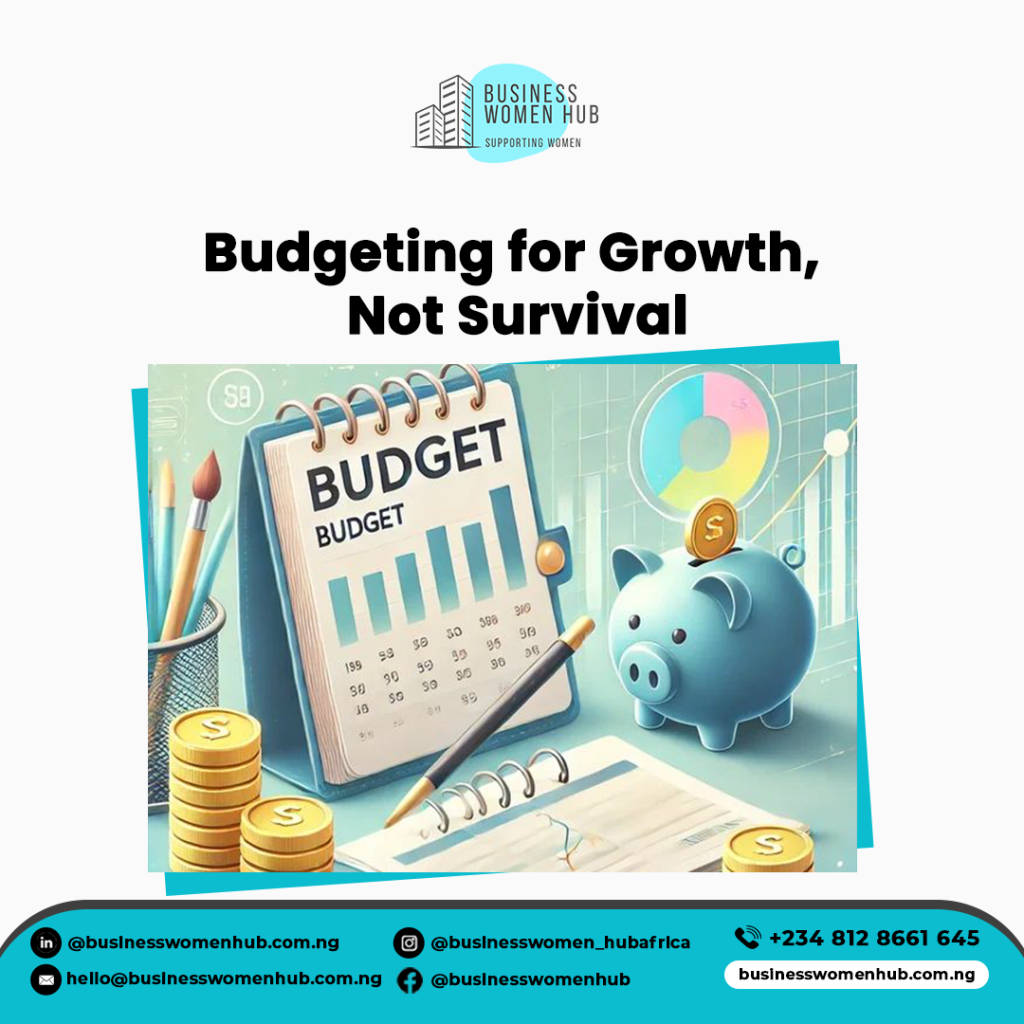
Budgeting for Growth, Not Survival: A Smarter Way to Use Your Money

For many women in business, budgeting has become a means of coping rather than a tool for building. We budget to pay bills, cover emergencies, and “manage till next month.” While this approach keeps the lights on, it often keeps our businesses stuck in a state of survival mode.

Growth requires a different mindset. Budgeting for growth is not about restriction; it’s about direction. It’s about telling your money where to go so it can support the future you’re intentionally building.

Let’s break down how to shift from survival budgeting to growth-focused financial planning.

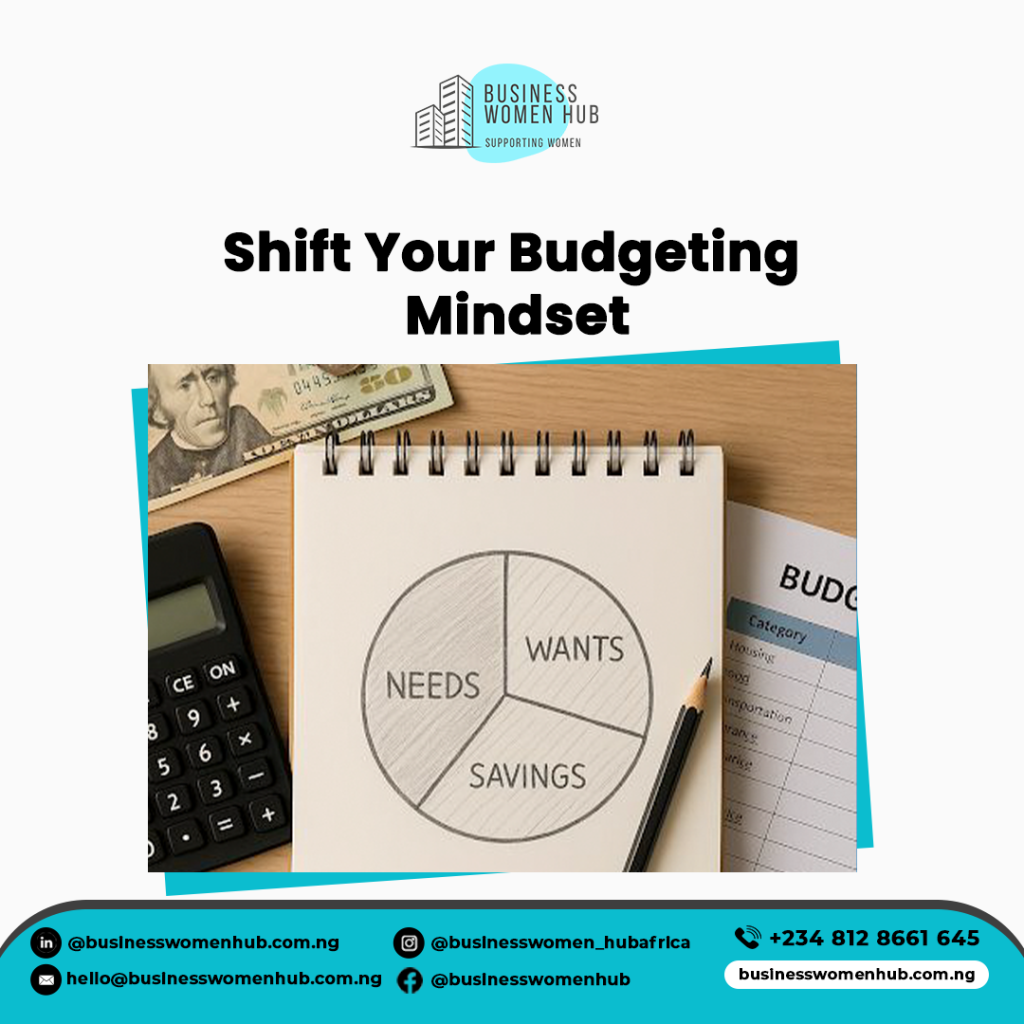
Shift Your Budgeting Mindset

Budgeting is not about restriction; it’s about direction.
Survival budgeting focuses on fear and short-term needs. Growth budgeting asks a more powerful question: What do I need to invest in to move my business forward this year? When you budget only to survive, your business stays reactive. When you budget for growth, your business becomes intentional.

To shift your mindset:

  • Stop budgeting only for bills and emergencies
  • Start budgeting with clear business goals
  • Define what growth looks like for you this year
  • Decide where your money should work harder

When you move from managing money to directing money, clarity follows.

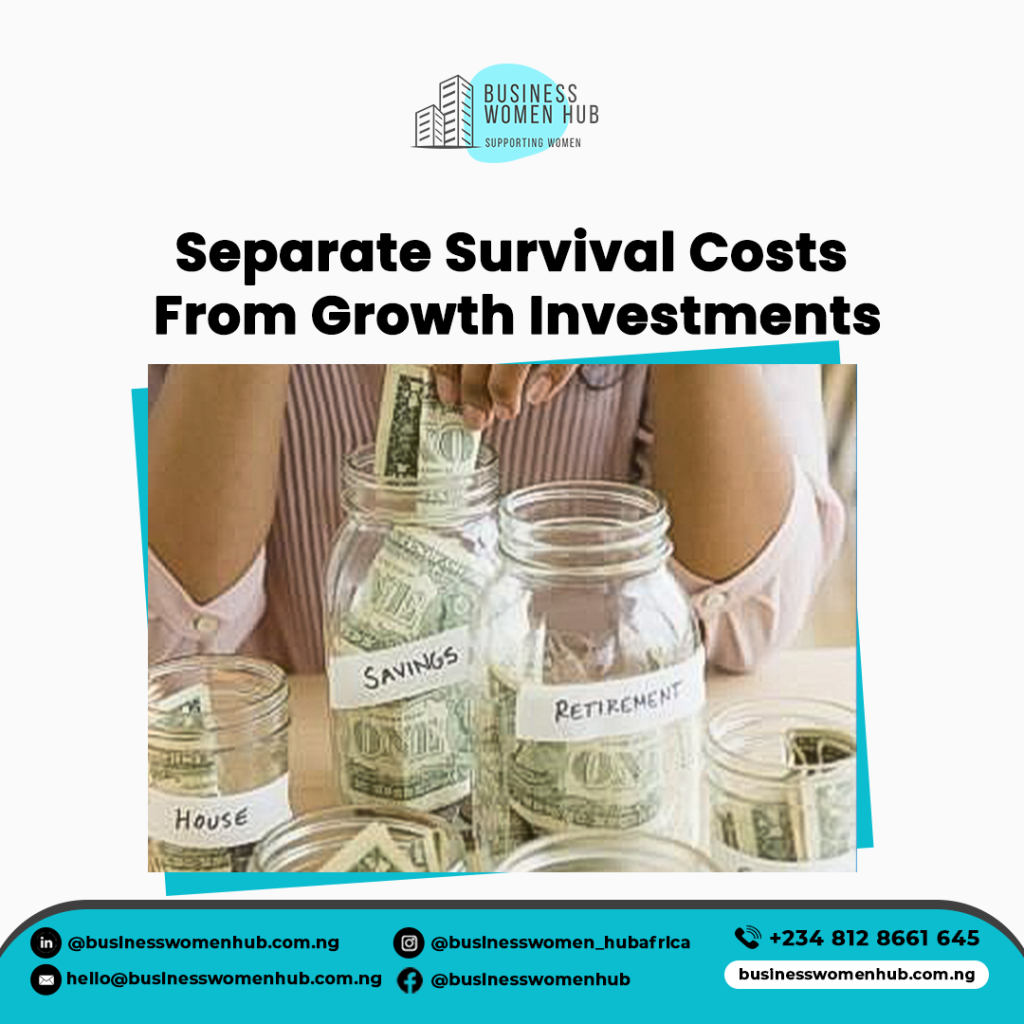
Separate Survival Costs From Growth Investments

Not every expense contributes to growth. Survival costs keep your business running, while growth investments help it scale. Mixing the two often leads to spending without progress.
Survival costs include rent, basic tools, internet, and utilities.
Growth investments include marketing, training, branding, systems, and support.

To create clarity:

  • List your monthly survival costs
  • Identify areas of overspending
  • Create a separate category for growth investments
  • Be honest about what’s draining your business versus building it

Growth happens when progress is intentionally funded.

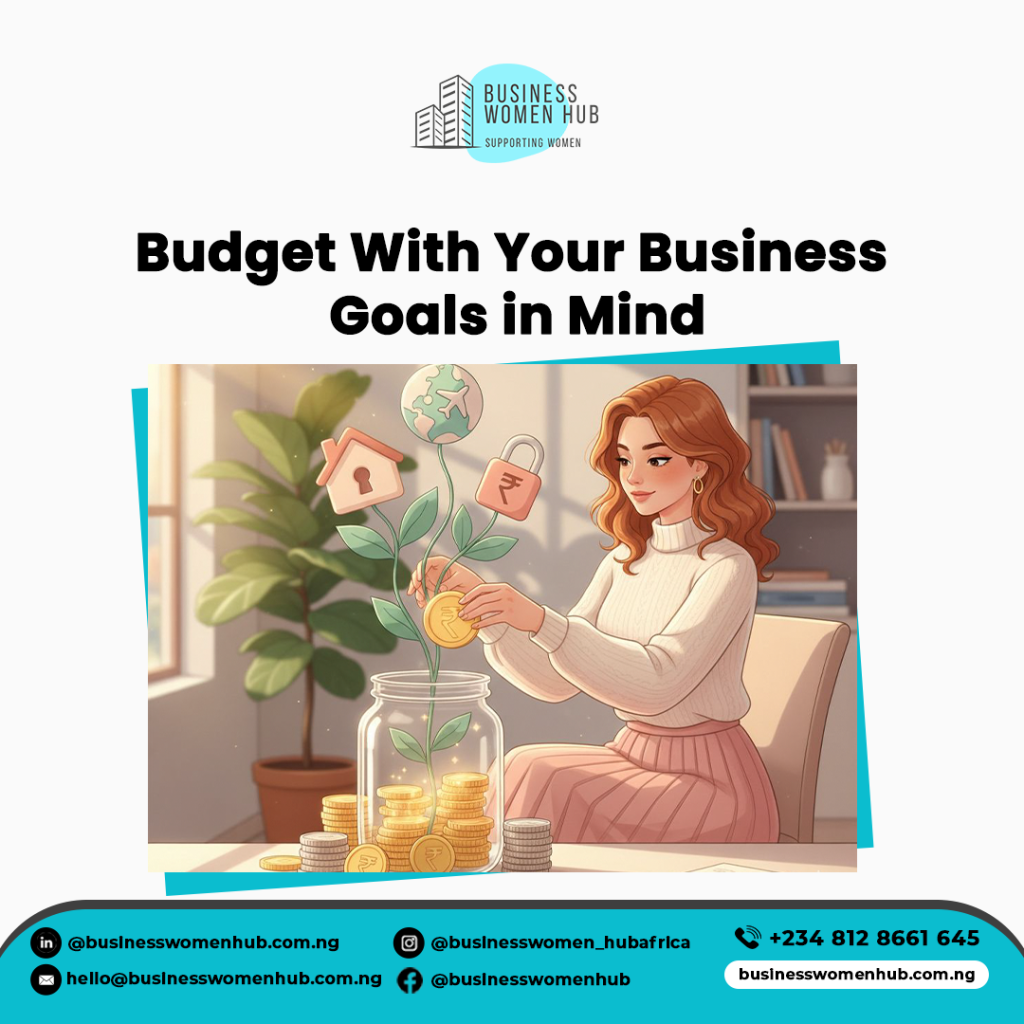
Budget With Your Business Goals in Mind

Your budget should support where you’re going, not just where you are.
If your goals include getting more customers, increasing visibility, improving systems, or earning more consistently, your budget must reflect those priorities. Big goals without financial backing remain wishes.

To align your budget with your vision:

  • Write down your top three business goals
  • Ask, “What will it cost to achieve this?”
  • Allocate money to income-generating activities
  • Cut back on expenses that don’t support your goals

When money follows vision, results follow too.

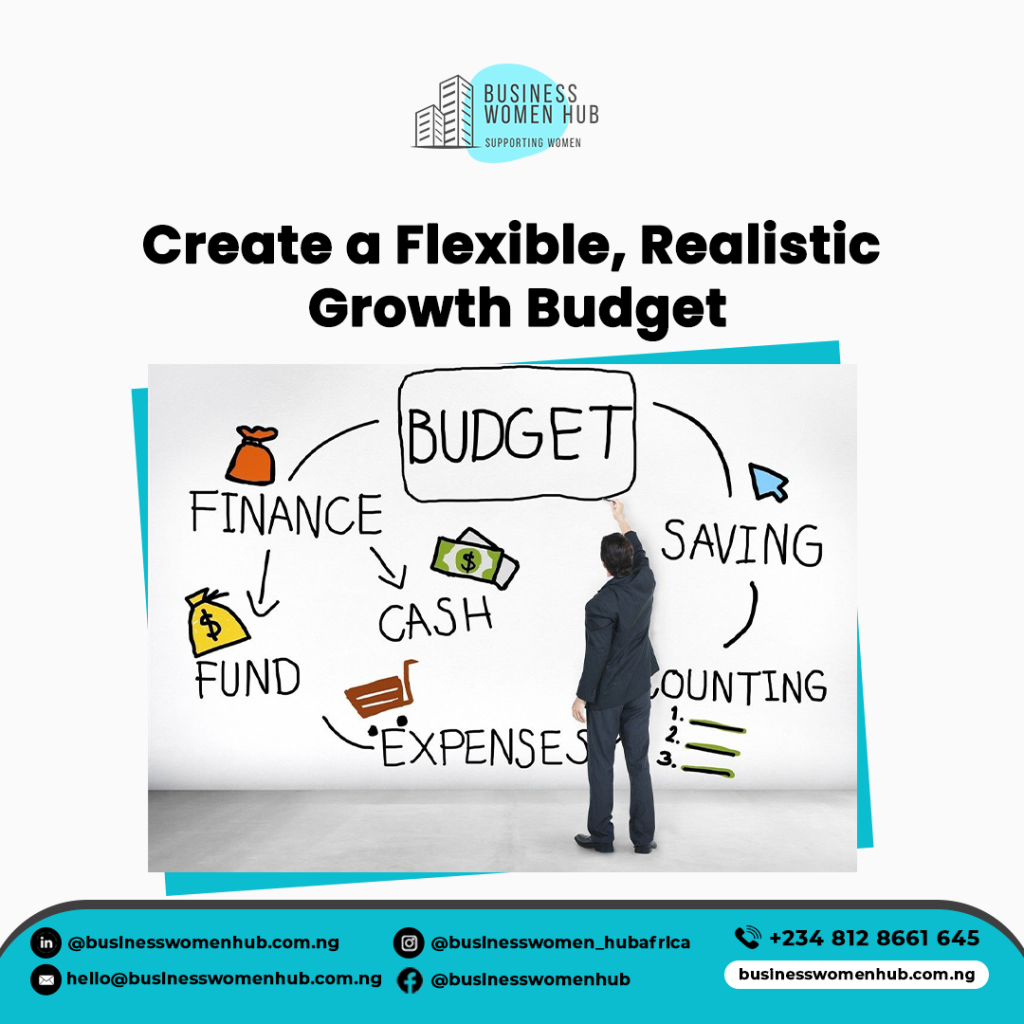
Create a Flexible, Realistic Growth Budget

Growth budgeting doesn’t require perfection; it requires consistency. You don’t need a large income to budget for growth. You need honesty, discipline, and flexibility. A good growth budget evolves as your business grows.

A healthy growth budget:

  • It is realistic and easy to maintain
  • Allows room for adjustment
  • Encourages intentional spending

Start by:

  • Budgeting with what you currently have
  • Setting aside a small monthly growth fund
  • Tracking spending regularly
  • Adjusting as your income changes

When you budget for growth, you stop reacting to money and start leading with it.

Final Thought

Budgeting for growth is a powerful act of leadership. It’s a decision to believe in where your business is going and to fund that belief with intention. Choose growth. Choose clarity. Choose to build beyond survival.

Posted on Leave a comment

From Busy to Profitable: How to Set Business Goals That Actually Make You Money This Year

As a new year begins, many women entrepreneurs sit down to set goals with excitement and high hopes. “Post more.” “Get more followers.” “Be more consistent.”
While these goals sound productive, they often lead to one thing: busyness without profit.

This year, it’s time to shift the conversation. Profitable growth doesn’t come from doing more; it comes from doing what matters. Here’s how to set business goals that are intentional, sustainable, and directly connected to revenue.

Shift From Busy Goals to Profitable Goals

Not all goals grow your business. Some only keep you occupied. Activity alone does not guarantee income. Profitable goals focus on outcomes, not just effort. Instead of asking, “How can I do more?”, profitable women ask, “What actually moves my business forward?”
Profitable goals help you:

  • Align your time with revenue
  • Stop doing what looks good but pays little
  • Focus on activities that drive real growth
  • Measure success beyond likes, views, and followers

To get started:

  • Identify the activities that brought in money last year
  • Separate revenue-generating tasks from support tasks
  • Ask, “Does this goal directly or indirectly lead to income?”
  • Prioritize clarity over volume
  • Choose fewer goals with clearer impact

A profitable year begins when you stop chasing busy and start choosing intentionally.

Set Goals That Match Your Capacity

Big goals are inspiring. Burnout is not. One common mistake many women make is setting goals based on pressure, comparison, or excitement, without considering their capacity. Profit doesn’t come from exhaustion; it comes from sustainability.

Your goals must respect:

  • Your time
  • Your energy
  • Your resources
  • Your current season of life

Before committing to your goals:

  • Review your current workload honestly
  • Decide how much time you can realistically give your business
  • Set goals that fit your life, not just your ambition
  • Build margin for rest and learning
  • Focus on consistency, not overwhelm

Growth that lasts is built on realistic plans. Sustainable goals protect both your profit and your peace.

Tie Every Goal to a Clear Revenue Path

A goal without a revenue path is just a wish. If you want more income this year, every major goal must answer one critical question: How does this make money, or support making money?

Profitable goals are connected to:

  • Offers
  • Pricing
  • Clients
  • Systems
  • Visibility that converts

To create revenue-driven goals:

  • Link each goal to a specific offer or service
  • Decide how the goal supports sales or client growth
  • Clarify your primary income streams
  • Set numbers, not vague intentions
  • Break annual goals into clear monthly actions

When your goals are connected to revenue, progress becomes measurable and motivating. Clarity turns effort into earnings.

Review, Refine, and Commit With Confidence

Goal setting is not a one-time activity; it’s an ongoing process. Profitable women don’t just set goals; they review them, refine them, and recommit with intention. Flexibility is part of the strategy, not a failure.

To stay aligned:

  • Review your goals weekly or monthly
  • Track what’s working and what’s not
  • Adjust your approach without guilt
  • Celebrate small wins along the way
  • Stay committed, even when progress feels slow

Profitable goals grow with you. When you consistently review and refine, success becomes intentional, not accidental.

Final Thought

This year, don’t just set goals that keep you busy. Set goals that pay you, protect your energy, and move your business forward with purpose.
Profit is not about doing more.
It’s about choosing better.

Posted on Leave a comment

The Power of a Soft Launch: How to Strategically Introduce Your Offer in the New Year Without the Pressure

The new year often comes with a rush of noise, new goals, new offers, and endless promotions competing for attention. Many women wait until January 1st to announce what they’re launching, only to find their message lost in the crowd. That’s where a soft launch changes everything.

A soft launch isn’t about being loud. It’s about being intentional, strategic, and confident, warming up your audience before you ever ask them to make a purchase. If you want to enter the new year with momentum (not burnout), here’s how to create a soft launch strategy that works.

Warm Up Before You Launch

A soft launch starts long before the official announcement. Instead of disappearing and reappearing with a sales post in January, a soft launch allows you to prepare your audience mentally and emotionally. By the time you launch, they already understand the problem, trust your voice, and are curious about what’s coming.

A soft launch helps you:

  • Test your offer with less pressure
  • Build interest quietly and strategically
  • Gather feedback and early testimonials
  • Create familiarity before asking for the sale

What to do during this phase:

  • Start talking about the problem your offer solves
  • Share behind-the-scenes preparation and planning
  • Drop subtle hints like “Something new is coming.”
  • Reintroduce yourself and clearly state what you do
  • Focus on starting conversations, not campaigns

Launching works best when people already trust you. Soft launches are not silent; they are steady, intentional, and strategic.

Build Anticipation With Value

A successful soft launch doesn’t begin with selling; it starts with serving. Before you say “buy from me,” show your audience that you understand their struggles and that you have real solutions. Value builds trust. Trust builds authority. And authority leads to sales. This is where your content does the heavy lifting.

Ways to lead with value:

  • Educate around the core problem your offer solves
  • Share quick tips, mini-lessons, or FAQs
  • Address common mistakes your audience makes
  • Share personal experiences or client stories
  • Use captions, posts, and stories to teach consistently

People buy from those who help them before they need help. When you give value freely, your audience starts asking, “How can I work with you?”

Activate Your Warm Audience

Not everyone who follows you is ready to buy, and that’s perfectly fine. A soft launch focuses on the women who are already paying attention.

Your warm audience includes those who:

  • Watch your stories regularly
  • Reply to your broadcasts
  • Comment on your posts
  • Ask questions in your DMs

They don’t need convincing. They need clarity.
How to activate them:

  • Speak directly to your warm audience
  • Use phrases like “If you’ve been following me…”
  • Invite conversations through DMs, polls, and Q&As
  • Offer early access or first dibs
  • Pay close attention to feedback and objections

A warm audience converts faster than a cold one. Soft launches succeed when you nurture instead of rushing your people.

Make a Gentle, Confident Offer

Yes, soft launches still involve selling. The difference is how you sell. You don’t need hype or pressure. You need clarity, honesty, and confidence.

Tell your audience:

  • What the offer is
  • Who it’s for
  • The problem it solves
  • How it helps
  • How to get started

How to present your offer:

  • Introduce it naturally within your content
  • Use simple, clear language
  • Invite rather than pressure
  • Share why you created it
  • Make the next step easy and obvious

The right people don’t need convincing; they need direction. A soft launch allows you to sell without stress, pressure, or burnout, while building momentum for the new year.

In Summary

A soft launch gives you room to breathe, test, refine, and connect, before the big push. As you prepare for the new year, remember this: you don’t need to shout to be seen. You need strategy, consistency, and trust. And that’s exactly what a soft launch helps you build. 💙

Posted on Leave a comment

What Worked, What Didn’t, and What to Let Go Of: A Powerful Reflection Guide for Women in Business

As the year draws to a close, or as you prepare for a new season in your business, it’s tempting to rush straight into goal-setting and planning. But real growth doesn’t begin with a to-do list; it starts with reflection. Taking time to review what worked, what didn’t, and what no longer serves you is one of the most powerful things you can do as a woman building a sustainable business.

This reflection isn’t about judgment or pressure. It’s about clarity, alignment, and intentional growth. Here’s a four-part guide to help you reflect deeply and move forward wisely.

Celebrate What Worked (Yes, Even the Small Wins)

Before you plan your next move, pause and look back. Reflection is not a luxury; it’s a growth tool. You can’t build forward without acknowledging what already worked.
Your wins don’t have to be loud to be valid. What worked might look like consistent posting, better customer engagement, repeat clients, improved systems, increased confidence, new skills, or simply not quitting when things got hard.
Take stock of your progress honestly and without comparison. Growth is often quiet, steady, and deeply personal.

Take time to:

  • Review your wins: sales, visibility, confidence, and skill-building
  • Identify strategies that brought results, even small ones
  • Note habits that supported your growth
  • Celebrate progress, not perfection
  • Document lessons you want to repeat in the new year

What you acknowledge, you can multiply. If something worked once, it can work again, with refinement. Growth begins with gratitude.

Be Honest About What Didn’t Work

Not everything that didn’t work was a failure. Some efforts were experiments. Some were lessons. Others simply weren’t aligned with your season or audience. Avoiding what didn’t work only keeps you stuck in cycles that don’t serve you. Mature businesses are built on honest evaluation, not denial.
Ask yourself: Was the issue strategy, consistency, timing, clarity, or alignment?

Reflect by:

  • Reviewing campaigns, offers, and efforts that fell flat
  • Identifying where consistency was missing
  • Assessing whether your pricing, messaging, or audience was misaligned
  • Separating emotions from data and focusing on facts
  • Writing down lessons, not excuses

Failure ignored repeats itself. Failure reviewed becomes wisdom. Growth doesn’t require shame; it requires clarity. Learn the lesson and move forward wiser.

Let Go of What No Longer Serves You

Not everything deserves a place in your next season. Some habits, beliefs, strategies, and expectations have expired. Holding on to what drains you blocks what’s trying to grow. Letting go is not quitting. It’s choosing alignment.
This is the season to release pressure, comparison, and outdated expectations.

Make space by:

  • Releasing strategies that caused stress but delivered no results
  • Stopping the habit of copying others without clarity
  • Letting go of perfectionism that delays action
  • Dropping clients, platforms, or routines that drain your energy
  • Releasing the belief that rest equals laziness

You grow faster when you travel lighter. Make space. The next season of your business needs room to breathe.

Refine, Reset, and Realign

Reflection becomes powerful only when it leads to action. This is where wisdom meets planning. Take what worked and improve it. Take what didn’t and refine it. Take what drained you and release it. This is how businesses evolve and mature.

Move forward by:

  • Doubling down on strategies that brought results
  • Simplifying your goals to ensure sustainability
  • Setting clear boundaries around your time, energy, and focus
  • Planning with intention, not pressure
  • Entering the new season with clarity, not chaos

The goal is not to do more. The goal is to do what matters, better. You are not starting from scratch. You are starting from experience. Reflection is a gift you give your future self. Use it well.

Posted on Leave a comment

Build a Powerful Business Profile: 4 Guide to Level Up Your Brand Online

Your business profile is more than just a page; it’s your digital handshake, your storefront, and your credibility all in one. First impressions happen in seconds, and your profile can either attract your ideal customers or send them scrolling past.

Here’s how to build a profile that not only looks professional but converts visitors into loyal clients.

Your Profile Is Your First Impression, Make It Count

Before anyone buys from you, they check your profile. A well-set profile instantly communicates: “You can trust me. I know what I’m doing.”
Here’s how to make your profile shine:

  • Professional profile picture: Use a high-quality headshot or your logo.
  • Clear business name: Keep it consistent across platforms.
  • Simple, direct bio: Explain who you are, what you offer, and who you serve.

  • Easy-to-find contact info: Make it clickable for convenience.

  • Pin important posts: Introductions, bestsellers, and testimonials.

A clear profile eliminates confusion and builds trust instantly. People decide in seconds whether to stay or leave; make every second count.

Craft a Bio That Sells

Your bio isn’t just a description; it’s your marketing tool. It should speak directly to your ideal customer: “This page is for you.”
Here’s how to write a bio that converts:

  • Start with what you do: “Helping women…”, “We provide…”, “I create…”
  • Add the transformation: Show the result your customer will get.
  • Include searchable keywords: Make it easy for people to find you.
  • Include a call-to-action: “Shop via link”, “Send a message”, “Book a consultation.”

Your bio should answer three key questions instantly: Who are you? What do you offer? Why should they stay?

Highlight the Right Things, Not Everything

A great business profile is curated, not cluttered. Highlights act like mini folders that guide visitors through your brand story.
Focus on highlights that matter:

  • About Us: Share your story, values, and mission.
  • Products/Services: Clear categories make browsing easy.
  • Testimonials: Build trust with proof.
  • Delivery/FAQs: Reduce hesitation and answer questions fast.
  • Process/BTS: Show how you work behind the scenes.

Highlights help customers find what they need without endlessly scrolling your feed.

Make Your Page Easy to Buy From

A beautiful profile is good, but a convertible profile is better. If people visit your page and still don’t know how to order, you’re losing sales.
Make buying simple:

  • Clear CTA buttons: “Shop Now”, “WhatsApp”, “Book Now.”
  • Price lists or product guides: Put them in your highlights.
  • Short ordering process: 1–3 steps is ideal.
  • Display payment options clearly: Make it easy to pay.
  • Respond quickly: Speed is part of your brand.

When buying from you feels effortless, customers return again and again.

Your business profile is your first impression, your sales pitch, and your credibility all rolled into one. Follow this guide to transform your page into a powerful tool that attracts, convinces, and converts.

Posted on Leave a comment

BUILD IT RIGHT: The Ultimate Guide to Structuring & Registering Your Business

Before the profits, before the fancy branding, and long before the marketing campaigns… There is one thing that every successful business stands on: structure.

Most entrepreneurs don’t fail because they lack skill, passion, or ideas. They fail because the business lacks a clear identity, a solid legal foundation, and a framework for growth. Structure is not a luxury; it is the backbone of every sustainable brand.
Below is a breakdown on how to build a business that is not just running… but built to last.

Structure Before Success

Before anything else, build structure. A business without registration is like a house without a foundation, one storm and it all collapses.
Registering your business is more than paperwork; it is the foundation that protects you, strengthens your brand, and creates opportunities you would never access otherwise.

Here’s what proper structure does for you:

  • Gives your business a legal identity
  • Protects your name from being claimed by someone else
  • Builds customer trust (registered brands are taken more seriously)
  • Opens doors to grants, loans, partnerships, and corporate contracts
  • Helps you separate your personal finances from your business finances

Reflection for the week: Is my business built to grow… or just built to survive?

Choosing the Right Business Type (It Matters!)

Not every business should be registered the same way. Your structure affects your tax, ownership, liability, and long-term possibilities.

Here are the main options every entrepreneur should understand:

  • Business Name (BN): Best for solo or small operators. Easy to register and manage, but offers limited protection. Great for makeup artists, food vendors, freelancers, and small retail brands.
  • Limited Liability Company (LTD): A separate legal entity that protects your personal assets. It carries stronger credibility and unlocks bigger opportunities. Perfect for tech startups, fashion brands, service companies, and growing businesses.
  • NGO / Incorporated Trustee: Ideal for non-profits, social impact initiatives, and community projects.

Key takeaway: Don’t register a business “because someone else used it.” Register for the future you’re building, not the present you’re in.

Why Business Registration Protects You

A registered business isn’t just a certificate; it’s a shield.
Here’s how it protects you:

  • Name protection: Once registered with CAC, no one else can use your name.
  • Legal protection: LTDs safeguard your personal assets if something goes wrong.
  • Financial clarity: Investors, banks, and partners trust structured businesses.
  • Ownership security: Your business becomes transferable and inheritable.

Registration is not an expense; it’s peace of mind. When your business is structured, you can grow without fear.

Documentation Every Business Should Have

Even with registration, your business is not fully protected without the right documents.
Every serious business needs:

  • CAC Certificate: Your official legal recognition
  • TIN (Tax Identification Number): Required for compliance and business banking
  • Business Bank Account: Essential for proper financial separation
  • Founders’ or Partnership Agreement: To avoid misunderstandings and future conflict
  • Operating Policies & Basic Contracts: Terms for payments, delivery, refunds, and services

A structured business does not operate on “verbal agreements.” Documentation protects your money, your time, and your peace of mind.

Posted on Leave a comment

SEO Made Simple for Women in Business: Your Guide to Being Found, Chosen, and Visible

In today’s business world, visibility is not a luxury; it’s a lifeline. And the truth is simple: if your dream clients can’t find you, they can’t buy from you.

Search Engine Optimization (SEO) may sound technical, but it’s one of the easiest, most effective tools for women in business who want to grow without spending heavily on ads. This beginner-friendly guide breaks it down into four powerful steps you can start applying immediately.

If You Can’t Be Found, You Can’t Be Chosen

You don’t have to be a tech expert to understand SEO; you just need to know this: People are already searching for what you offer. But can they find you?
SEO (Search Engine Optimization) simply makes your business easier to discover online, especially on Google.

If your ideal customer typed:

  • “headwraps in Abuja”
  • “business coach for women”
  • “Healthy snacks Lagos” …would your business appear?

Here’s how to start increasing your visibility today:

  • Use clear keywords in your bio, website, and captions
  • Add your business location if you serve a specific area
  • Write captions that answer real questions people search for
  • Make sure your business name + what you do is visible everywhere
  • Create content that your customer would actually Google

Visibility is not luck; it’s strategy. Show up in the places where people are already searching.

Keywords Are Your Digital Currency

Keywords are the exact words and phrases people type into Google when they’re looking for solutions. When you use the right ones, search engines start sending people to you, for free.

That’s how SEO becomes a powerful growth engine:

Your content becomes searchable.
Your brand becomes discoverable.
Your business becomes visible.

Simple keyword habits that make a big difference:

  • Describe your product/service using common search terms
  • Add FAQs to your captions or website (“How to…?” “Where to…?”)
  • Use keywords naturally, not forcefully
  • Check Google autocomplete to see real-time searches
  • Create content around the questions customers ask daily

The right keywords attract the right customers. Speak the language your audience is searching for.

Your Website (or Page) Must Do the Talking

SEO isn’t only about posting; it’s also about how your online home is set up.
Your website or business page should be: Simple. Search-friendly. Clear.
If Google can’t understand your brand, it can’t recommend you.

Here’s what to optimize:

  • Your About section: who you are + what you offer
  • Product/service descriptions: include keywords + benefits
  • Page titles: be specific (e.g., “Home | Natural Hair Products in Lagos”)
  • Image names: rename files with relevant keywords
  • Links: short, clickable, and professional

When Google understands your brand clearly, visibility becomes automatic.

Create Content Google Loves

Good SEO is rooted in valuable content, content that educates, solves problems, and speaks directly to your audience. Google rewards brands that are helpful.
To rank higher, focus on content that:
Educates
Answers questions
Solves problems
Connects with your audience

SEO-friendly content ideas:

  • Tutorials (“How to style…” “How to choose…”)
  • Lists and tips (“5 ways to…”)
  • FAQs
  • Blog-style captions
  • Case studies and testimonials
  • Location-based content (“Where to find…”)

Give Google useful content, and Google will give you visibility.

Posted on Leave a comment

THE POWER OF BUSINESS RESILIENCE: How Strong Women Rise, Adapt & Lead

In the world of business, storms are guaranteed. Markets shift, clients change, challenges come unannounced, but the women who rise, thrive, and build lasting legacies all have one thing in common: resilience.

This week’s theme dives into the unshakeable foundation every woman entrepreneur must build to succeed: the ability to keep standing, keep showing up, and keep evolving no matter what comes your way.

Storms Will Come, But You Must Stand

Every successful woman in business has a story. A slow month. A lost client. A tough mistake. A financial setback. For a moment, she almost gave up. Resilience isn’t pretending everything is perfect; it’s choosing to rise every time life or business tries to break you.
Here’s your reminder: Your strength isn’t measured by how smoothly things go, but by how you respond when things get tough.

Your resilience checklist:

  • Accept challenges as part of the journey, not evidence of your failure
  • When things feel chaotic, pause → breathe → observe → respond
  • Track both your wins and lessons; they are equally important
  • Build systems so your business doesn’t collapse when you feel overwhelmed

Resilient women don’t avoid storms; they walk through them with wisdom. Your business won’t grow because everything is easy; it will grow because you refuse to stay down.

Discipline Beats Motivation Every Time

Motivation is a feeling. Discipline is a decision. And resilient entrepreneurs understand this deeply. If you only show up when you feel inspired, your business will remain unstable. But when you show up with discipline — even on low-energy days — you create momentum.

Build your discipline muscle:

  • Choose small, non-negotiable daily or weekly actions
  • Create routines that keep your business moving
  • Fight procrastination — it steals opportunities
  • Use simple tools: reminders, planners, calendars, systems

Discipline isn’t punishment; it is self-respect. And when motivation disappears (because it will), discipline becomes your backbone.

Adaptability Is Your Superpower

The business world evolves quickly; trends, customers, platforms, and even expectations shift overnight. The most resilient women aren’t the strongest… they’re the most adaptable. When something isn’t working, resilience means adjusting, not quitting.

Become adaptable by choice:

  • Review your strategies often and update what’s not effective
  • Listen to your customers; their feedback is free guidance
  • Stay open to new tools, platforms, and methods
  • Embrace reinvention: it’s a sign of growth, not confusion

Adaptation isn’t losing yourself. It’s upgrading yourself. Relevance comes from flexibility.

Protect Your Energy, It’s a Business Asset

Your business can only be as strong as you are. Burnout doesn’t just affect your mood; it affects your creativity, consistency, and decision-making. Resilience isn’t just pushing through. It’s also knowing when to preserve yourself.

Protect your energy like a CEO:

  • Say “no” when something doesn’t serve you
  • Rest without feeling guilty
  • Delegate tasks that drain your spirit
  • Surround yourself with people who energize and uplift you

A clear mind and healthy energy create a high-performing business. Your well-being is part of your business strategy, not an afterthought.

Posted on Leave a comment

Sustaining Success with Intention: A Guide for Women Ready to Grow on Purpose

Success is not a race, it’s a rhythm. For women in business, sustaining success requires more than hustle; it demands intention, clarity, strategy, and a willingness to evolve. Too often, we fall into the trap of “doing more” – more clients, more revenue, more noise, believing that speed equals strength.

But what if your growth journey could be different? What if instead of chasing momentum, you focused on what truly matters? What if your success was defined not by how fast you move, but by how powerfully and purposefully you build? This guide will help you build a business that grows with purpose, not pressure.

Growth with Purpose, Not Pressure

As women in business, we’re conditioned to chase more: more clients, more revenue, more visibility. But sustainable success isn’t about doing more. It’s about doing what matters most.
The most powerful entrepreneurs don’t just move fast; they move with meaning.

Here’s your reminder:

  • Refocus your energy: Not everything that grows is good growth. Choose alignment over activity.
  • Strengthen your systems: A thriving business runs on structure, not stress.
  • Lead with clarity: Your team, clients, and brand take direction from you; stay focused.
  • Protect your peace: Burnout is not a strategy. Rest is fuel.
  • Revisit your ‘why’: When things feel blurry, reconnect with your original fire.

You’ve already proven you can build, now grow intentionally. Let your evolution be defined by purpose, not pressure.

Clarity Turns Ideas into Strategy

A great idea is only the beginning. Clarity is what transforms it into a business that wins.
When you’re clear, your message lands, your marketing aligns, and your momentum accelerates. Confusion, on the other hand, slows everything down. Sharpen your business idea until it becomes powerful, purposeful, and profitable.

Gain clarity by focusing on:

  • Define your purpose: Why does your brand exist beyond profit?
  • Identify your audience: Who are you serving and what change do you help them achieve?
  • Craft your value promise: What unique benefit sets you apart?
  • Map your path: Outline short-term goals and your long-term vision.
  • Stay consistent: Every product, post, and decision should echo your core purpose.

✨ Remember: confusion costs opportunities. Clarity creates demand.

Turn Strategy into Action

Clarity without execution is just a dream on paper. The difference between inspiring ideas and impactful businesses is consistent action. You don’t need to do everything immediately, just the right things intentionally.

Here’s how to activate your strategy:

  • Prioritize: Focus on tasks that drive results, not the ones that fill your time.
  • Plan your week: Break big goals into small daily steps.
  • Stay accountable: Track your wins, no matter how small.
  • Choose progress over perfection: Done is always better than perfect.
  • Maintain momentum: Small, consistent actions lead to unstoppable success.

Execution creates evidence. Each step proves your idea works and builds your confidence to keep going.

Refine, Improve, and Evolve

Once your idea is in motion, the real magic begins. Success isn’t about getting it perfect on the first try; it’s about staying adaptable and improving as you grow. The best businesswomen evolve with intention.

Keep improving your idea by:

  • Collecting feedback: Your customers reveal what’s working and what needs adjustment.
  • Reviewing your results: Understand what’s driving impact.
  • Staying open-minded: Innovation thrives on curiosity.
  • Revisiting your goals: Ensure your actions align with your bigger picture.
  • Upgrading continuously: Don’t wait for perfect, refine as you rise.

Great businesses aren’t built overnight. They’re built through observation, adaptability, and evolution.